
Views: 0 Author: Site Editor Publish Time: 2026-08-10 Origin: Site


Do you struggle with high reject rates for premium fruit shipments? Post-harvest bruising and pitting drive significant retailer rejection and revenue shrink every season. Delicate fruits require precise packaging to survive harsh handling and long-distance transit. Packinghouse managers face a constant, difficult battle. You must balance maximizing freight density to pack more fruit per pallet against minimizing bottom-layer compression. Finding this exact balance dictates whether your produce arrives pristine or heavily damaged.
We will explore the precise mechanics of compression and impact damage below. You will discover an evidence-based framework for evaluating tray dimensions, material rigidity, and packing line compatibility. We will detail exactly how headspace rules and material choices safeguard your bottom line. Read on to protect your premium fruit margins and reduce costly shrinkage across your entire supply chain.
Optimal cherry clamshell tray depth is not universal; it must map directly to fruit caliber (row size) and packing line drop heights.
Excessive depth increases the risk of bottom-layer compression bruising, while insufficient depth leads to top-layer crushing from lid pressure.
Material selection (e.g., rigid PET Fruit Tray vs. molded fiber) directly alters the effective depth required for safe transport.
Procurement decisions should require supplier transit simulation data (vibration and compression testing) prior to bulk purchasing.
Bruising ruins premium fruit value instantly. It occurs in two primary stages during the packaging lifecycle. You must understand both impact and compression mechanics to design an effective defense strategy.
Impact damage happens before the fruit even leaves your facility. It occurs when cherries drop from the automated filler or hopper into the empty packaging. The distance from the dispensing unit to the bottom of the tray directly dictates pitting damage. Deeper profiles create a longer free-fall for the first layer of fruit. This sudden impact against rigid plastic causes micro-fractures in the fruit tissue.
To combat this, deeper trays require specific packing line drop-height modifications. You might need to install deceleration chutes. You could also adjust the hopper release angles to soften the initial fall. Packhouse managers often overlook this step. They assume packaging handles the impact naturally. However, unprotected drops exceeding a few inches will invariably cause pitting.
Transit damage operates on the physics of weight distribution. When pallets travel across bumpy highways, they endure continuous vibration. This movement forces the top layers of fruit to settle downward. The volume-to-depth ratio places exponential pressure on the bottom tier of fruit during these prolonged transit vibrations.
A deep container holds higher volumes. This seems great for density. However, more volume means more vertical weight resting directly on the bottom layer. Over an extended journey, this vertical load flattens the fruit. The prolonged static weight combines with kinetic road shocks. This combination rapidly breaks down the cellular structure of delicate produce.
You must define an acceptable threshold of fruit-on-fruit pressure. We base this threshold on specific firmness metrics. Sweet cherries and soft berries respond differently to weight.
Sweet Cherries: Firmness typically exceeds 250 g/mm. They can handle moderate stacking.
Raspberries: Highly delicate. They require extremely shallow profiles to prevent rapid crushing.
Blueberries: Moderate firmness. They tolerate slightly deeper layers than raspberries but less than cherries.
Matching your packaging to these specific tolerances is non-negotiable. Soft fruits demand shallow environments to spread weight horizontally. Firmer fruits allow for better vertical volume utilization.
You cannot rely on a one-size-fits-all approach. Your container depth must align perfectly with your specific harvest metrics.
Standard off-the-shelf options often fail premium, large-caliber crops. An 8-row cherry measures significantly larger than a 10.5-row cherry. If you place 8-row cherries into a shallow container designed for smaller calibers, the lid will crush the top layer upon closure. Conversely, putting small cherries into an overly deep container causes excessive shifting during transit.
You must select dimensions based on your specific crop yield. Premium export cherries require customized cavities to prevent unnecessary friction and movement.
The agricultural packaging industry relies on a few standard depth profiles. Shallow profiles typically measure around 1.5 inches. Deep profiles can exceed 3 inches.
Depth Profile | Typical Measurement | Best Suited For | Compression Risk Level |
|---|---|---|---|
Ultra-Shallow | Under 1.5 inches | Raspberries, Blackberries | Low |
Standard Shallow | 1.5 to 2.25 inches | Blueberries, Small Cherries | Moderate |
Standard Deep | 2.25 to 3.0 inches | Standard Cherries, Grapes | High (requires careful handling) |
Extra Deep | 3.0+ inches | Bulk export firm fruits | Very High (needs line modifications) |
Proper headspace guarantees successful pallet stacking. The headspace rule involves calculating the exact millimeter clearance required between the top layer of fruit and the closed lid. You must maintain this gap to prevent pressure damage.
When workers stack boxes on a pallet, the plastic slightly flexes under the weight. If your fruit sits flush against the lid, this downward flex transfers directly into the produce. We recommend maintaining a minimum 3-5mm clearance gap. This ensures the structural integrity of the plastic bears the pallet weight, not the fruit.
Standardized tooling works well for average crops. However, premium harvests require custom procurement. When discussing your specific needs with manufacturers, determining the precise cherry clamshell tray depth ensures your packaging protects your highest-margin goods. Custom depths eliminate the dangerous guesswork of forcing large fruit into standard molds.
Depth alone does not dictate protection. The material enclosing the fruit heavily influences how well that depth performs under real-world stress.
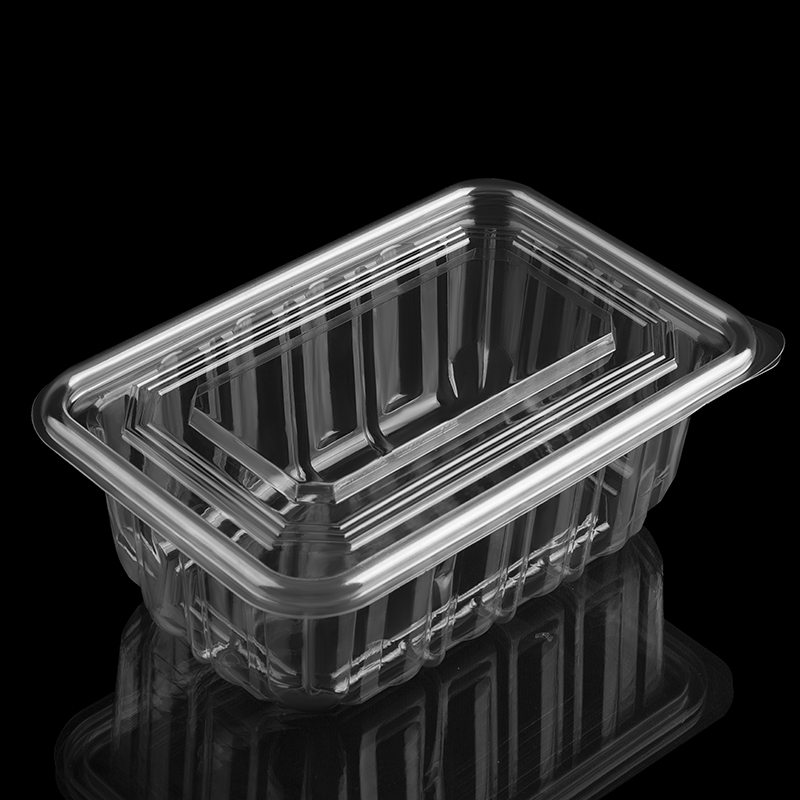
Plastic materials dominate the market for good reason. A well-engineered PET Fruit Tray utilizes specific physical features to supplement its depth. Manufacturers build sidewall ribbing into the plastic. They also integrate base contouring, such as dimples or channels.
These features act as structural shock absorbers. They provide enhanced vertical crush resistance without requiring a deeper cavity. The ribbing redirects top-down weight around the fruit rather than through it. This allows you to pack pallets higher without compromising the produce at the bottom.
You must weigh the benefits of rigidity against natural cushioning. PET provides rigid, impermeable protection. It stops external objects from crushing the fruit. It holds its shape perfectly under pallet loads.
Molded fiber packaging offers a different approach. Fiber naturally absorbs some kinetic energy. It provides slight cushioning during transit bumps. However, fiber lacks the sheer vertical load-bearing capacity of ribbed PET. High-moisture environments also weaken molded fiber quickly. Rigid plastic maintains its structural integrity regardless of humidity or temperature fluctuations.
Deeper profiles inherently restrict internal airflow. The deeper the container, the harder it becomes to cool the center mass of the fruit. Proper temperature management prevents decay.
You must demand precision-engineered side and base ventilation holes in your PET packaging. Without adequate venting, deeper cavities trap heat. They encourage condensation and accelerate ethylene buildup. This inevitably leads to premature rot. Multi-level venting ensures forced-air cooling systems push cold air entirely through the fruit mass, dropping core temperatures rapidly.
Perfect packaging fails if your machinery cannot handle it efficiently. You must ensure new container designs integrate seamlessly with your existing automation.
Denesters automatically separate stacked containers and feed them onto the packing belt. Profile depth and stacking lug design heavily impact machine feeding. Improperly nested deep containers often stick together due to vacuum sealing or friction.
This leads to double-feeding. Two containers drop onto the belt simultaneously. This instantly causes severe line jams. It ruins fruit, halts production, and wastes labor. You must verify that the stacking lugs on your selected packaging create enough separation for automated suction cups to pull a single unit reliably every time.
Achieving target weights in deep containers presents a unique challenge. You typically target exact consumer weights, such as 1lb or 2lb increments. Deeper cavities often look visually underfilled even when they reach the correct weight.
Operators frequently overfill these containers to make them look full to the consumer. Overfilling completely negates the protective benefits of the depth. It forces fruit above the headspace line. The lid then crushes the top layer. You must calibrate automated weigh-fillers perfectly to prevent this optical illusion from causing physical damage.
Never commit your entire harvest to a new specification without physical testing. You must run a limited-batch trial on your existing denesters and closing machinery.
Test 5,000 units on the line at full production speed. Watch for denesting snags, hinge closing failures, and labeling alignment issues. A minor design flaw in a new profile can cost you days of downtime if discovered during peak harvest. Testing guarantees compatibility and protects your operational efficiency.
Choosing the right supplier is as critical as choosing the right dimensions. You need a partner who provides verifiable data and reliable logistics.
Performance Evidence: Buyers must demand empirical transit simulation data from the supplier. Do not settle for basic material specification sheets. Request ISTA (International Safe Transit Association) testing results. This data proves the packaging survives vibration and compression under real-world freight conditions.
Tooling & Customization Costs: Calculate the ROI for investing in custom molds. Compare this against the cost of adapting your operations to standard profiles. Custom molds require upfront capital but often reduce fruit shrink drastically. This reduction in lost product easily pays for the tooling within a single season.
Supply Chain Reliability: Assess the supplier's production capacity. Can they deliver a standardized Cherry Clamshell Box at scale during peak harvest? The harvest season is short, compressed, and high-stakes. Late packaging deliveries mean rotting fruit. Choose suppliers with redundant manufacturing facilities.
Compliance & Sustainability: Ensure your chosen material aligns with emerging retailer mandates. Major grocers demand recyclability. They also push for reduced plastic weight. Modern PET solutions must utilize post-consumer recycled (PCR) content and feature highly recyclable resin codes to keep your product on retail shelves.
The right container depth is never a random choice. It is a carefully calculated intersection of fruit size, automation constraints, and material strength. You must map your packaging precisely to your fruit caliber while strictly enforcing headspace rules to eliminate compression bruising.
We recommend conducting an immediate audit of your current packout reject rates. Identify whether your damage occurs at the hopper drop zone or during freight transit. Next, initiate a pilot run with two or three short-listed profiles on your packing line to test denesting and closure compatibility.
Take action before your next harvest begins. Request a technical consultation or order a physical sample kit today to test these specific geometries on your own automated equipment.
A: No. While it holds more volume, excessive depth increases weight on the bottom fruit, leading to compression bruising. Depth must strictly match the target weight and fruit caliber.
A: Softer berries have a much lower compression threshold and require significantly shallower tray depths with broader bases to distribute weight, whereas cherries can withstand moderate stacking.
A: Deeper trays require multi-level venting (base, mid-wall, and lid) to ensure rapid forced-air cooling reaches the center of the fruit mass, preventing ethylene buildup and rot.


