
Views: 0 Author: Site Editor Publish Time: 2026-09-03 Origin: Site


Product loss during transit and storage directly impacts agricultural and retail profit margins. The right material grade reduces shrink, extends shelf life, and ensures compliance. However, navigating the trade-offs between physical crush resistance, moisture defense in cold chains, and retail display aesthetics poses a constant challenge. Supply chain managers often struggle to balance ventilation needs against structural integrity.
Poor material selection leads to collapsed pallets, spoiled fruit, and rejected deliveries. Selecting the correct packaging grade is not just a logistical necessity; it acts as an insurance policy for your produce.
This article provides an evidence-based breakdown of material grades, covering corrugated board, solid board, and PET plastic. We will help procurement and supply chain teams specify the optimal packaging for fresh and dry produce. You will learn how to evaluate key performance metrics and choose a supplier capable of meeting your exact physical and regulatory requirements.
Corrugated board performance depends heavily on the Kraft-to-recycled liner ratio and Edge Crush Test (ECT) ratings, particularly in humid cold-chain environments.
Solid board offers superior moisture resistance and spatial efficiency for dense, heavy, or wet-cooled produce.
Food grade PET plastic provides unmatched retail visibility and moisture barriers, making it the standard for dry fruits and premium berry punnets.
Evaluating a fruit packaging box supplier requires looking beyond unit cost to assess Box Compression Test (BCT) data, Cobb values, and food safety certifications (BRCGS, FDA).
To evaluate a fruit packaging box properly, we must define what performance actually means in the field. Packaging does not just hold fruit; it actively protects agricultural investments through complex supply chains. We measure this performance across four primary dimensions.
Physical protection relies on specific testing metrics. The Box Compression Test (BCT) and Edge Crush Test (ECT) determine the ability of a box to withstand palletized stacking. Without sufficient BCT ratings, lower-tier boxes suffer deflection. This deflection transfers the pallet weight directly onto the fruit, causing mechanical damage and bruising.
Material behavior changes drastically when temperatures shift. We call this hygroscopic dynamics. Produce often moves from warm, humid fields directly into refrigerated cold storage. This rapid transition creates condensation. If the packaging material absorbs this moisture, the structural bonds break down. A box rated for high strength in dry conditions can easily collapse in a wet cooler.
Fresh produce breathes. It releases ethylene gas and heat. Packaging needs ventilation holes to allow this airflow and prevent accelerated ripening. However, punch-holes weaken the box structure. You must balance the necessary airflow for ethylene gas escape against the structural weakening caused by these cutouts. Precision engineering places these vents away from load-bearing corners.
Finally, performance includes consumer safety. Packaging materials must feature certified food-safe contact layers. Regulatory bodies establish strict chemical migration limits. If the packaging transfers harmful compounds to the produce, it fails the most fundamental performance test, regardless of its physical strength.
Corrugated board remains the global standard for moving bulk produce. However, not all corrugated boards perform equally. Understanding the specific material grades ensures your produce survives the journey from farm to distributor.
The paper composition directly dictates field performance. Virgin Kraft fibers come directly from tree pulp. They offer superior tensile strength and structural integrity under high humidity. The long fibers bind tightly, resisting moisture penetration.
Conversely, Testliner uses heavily recycled fibers. Every recycling cycle shortens the paper fibers. While Testliner is highly sustainable, it risks severe delamination in cold chains. When recycled board absorbs condensation, it loses up to 50% of its stacking strength.
The wavy inner layer of a corrugated board is the flute. You must match the flute size to the weight of your produce.
B-Flute: Excellent crush resistance and printability. Ideal for lighter produce and retail-ready packaging.
C-Flute: The industry standard. C-flute provides a highly effective balance of cushioning and vertical stacking strength.
BC Double-Wall: Combines B and C flutes. This grade is strictly for heavy, bulk transit like watermelons or large citrus loads.
Produce processing often involves hydro-cooling or ice-packing. A standard paper box will disintegrate under these conditions. Historically, the industry used wax coatings. Today, sustainability mandates require wax-alternative, recyclable water-resistant barriers. These modern polymer coatings maintain the performance of the fruit box during refrigerated transport while remaining fully recyclable.
Common Mistake: Many procurement teams over-specify the ECT rating while completely ignoring the Cobb value. The Cobb value measures the water absorption rate of the paper. A box possessing a massive ECT rating will still collapse if the liner paper quickly absorbs cold-chain moisture. Always evaluate ECT alongside moisture resistance.
Once produce reaches the retail environment, the packaging requirements shift. The focus moves from bulk transit protection to consumer visibility, portion control, and strict moisture barriers.
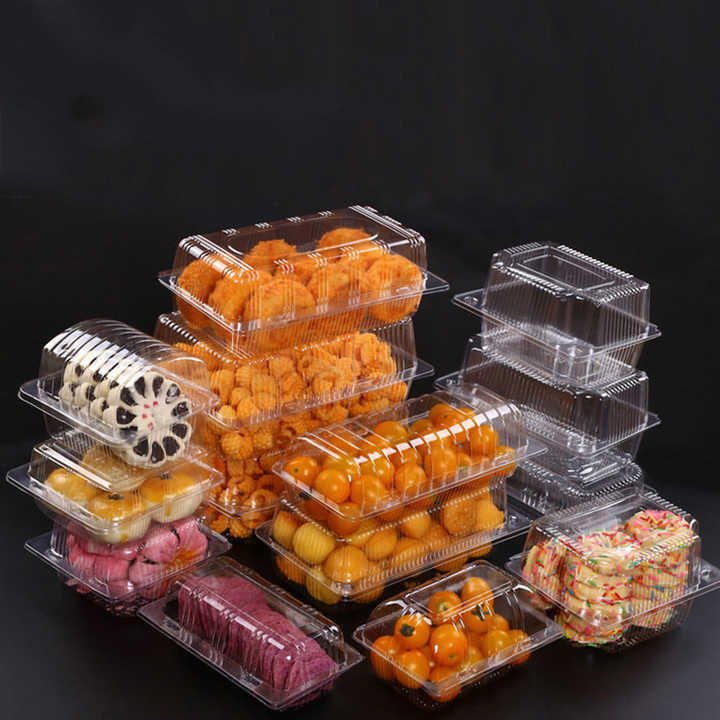
Clear rigid plastics remain dominant for bottom-of-funnel retail conversion. Consumers want visual confirmation of freshness. PET (Polyethylene Terephthalate) provides unmatched clarity, allowing shoppers to inspect berries, grapes, and cut fruit without compromising the package integrity.
You must specify different PET configurations based on the produce type.
For fresh berries: Use vented rPET (recycled PET). Berries require continuous airflow to prevent mold growth. Vented clamshells allow cooling air to circulate while protecting the delicate fruit from crushing.
For dry applications: Unvented, high-clarity PET is essential. For food grade pet plastic dry fruit packaging, you need tight seals. The plastic must act as an absolute moisture and oxygen barrier. This prevents spoilage, locks in flavor, and maintains the crispness of dehydrated products.
The industry is rapidly shifting toward rPET to meet environmental goals. However, evaluating rPET percentages requires care. High levels of recycled content can introduce structural brittleness and reduce optical clarity. Work closely with manufacturers to find the optimal blend. You want high recycled content without sacrificing the hinge strength of clamshell lids.
Best Practice: Always request documentation verifying regulatory compliance. You must ensure the polymer resin and any anti-fog additives are certified for direct food contact. Confirm alignment with FDA or EFSA guidelines before placing bulk orders.
For specific high-stress supply chains, standard corrugated board simply cannot survive. This is where solid board steps in. It provides exceptional durability in harsh agricultural environments.
Solid board uses highly compressed paper fibers. Options include solid unbleached sulfate (SUS) or recycled solid board. Because the fibers are compressed into a single dense layer, there are no air gaps (like corrugated flutes) for moisture to infiltrate. Solid board consistently outperforms standard corrugated in wet environments. It resists softening during rapid temperature changes.
Solid board is significantly thinner than corrugated board. This thin profile creates a major logistics advantage. You can fit more boxes onto a single pallet. Maximizing pallet density reduces outbound shipping requirements, lowering freight emissions and optimizing warehouse space.
Solid board works best in demanding scenarios:
High-Moisture Environments: Field packing during heavy dew or rain.
Vacuum Cooling Processes: Solid board withstands the intense pressure changes of rapid vacuum cooling without imploding.
Export Scenarios: Prolonged freezing, chilling, and extended ocean freight journeys where condensation is inevitable.
To avoid supply chain failures, you must look beyond basic dimensions. Professional procurement relies on specific engineering metrics. Below are the critical fruit packaging box specifications you need to verify.
BCT is the non-negotiable metric for pallet stacking. It measures the exact amount of weight a box can hold before buckling. Most crucially, laboratories must test BCT at expected cold-chain humidity levels (often 85% to 90% RH). Testing BCT in dry ambient conditions provides a false sense of security.
The Cobb test quantifies surface water absorption over a set period. A lower Cobb value dictates better survival in refrigerated transport. If you ship through high-humidity regions, demand heavily sized papers with very low Cobb values.
The optimal percentage of cut-out area for fresh produce typically ranges from 4% to 6%. This ratio allows rapid cooling without compromising structural integrity. Vents must avoid the vertical load-bearing corners of the box. Improperly placed vents destroy stacking strength.
Retail-ready packaging requires high-quality graphics. However, you must specify water-based, low-migration inks for flexographic or lithographic printing. Standard commercial inks contain volatile organic compounds. Low-migration inks prevent chemical transfer, maintaining strict food safety compliance.
Material Performance Comparison Summary
Material Grade | Primary Use Case | Moisture Resistance | Stacking Strength (BCT) | Space Efficiency |
|---|---|---|---|---|
Virgin Corrugated (Kraft) | Bulk transit, varied climates | Moderate to High (if coated) | Excellent | Moderate |
Solid Board (SUS) | Wet cooling, export freight | Very High | High | Excellent |
PET Plastic | Retail display, dry fruits | Absolute Barrier | Low (requires master cartons) | Low |
Finding a reliable manufacturing partner is just as important as selecting the right material. A credible fruit packaging box supplier operates as a technical consultant, not just a vendor.
Never buy bulk packaging based on a digital drawing. A qualified supplier should provide climate-chamber testing data. They must simulate your specific supply chain environments—from field heat to refrigerated transport. Demand physical prototypes to run through your automated packing lines before approving full production.
Food safety starts at the manufacturing facility. Conduct a mandatory evaluation of their operational certifications. Look for FSC (Forest Stewardship Council) sourcing for paper products to ensure sustainable forestry. For manufacturing hygiene, demand BRCGS or ISO 22000 certifications. These standards verify that the facility maintains food-safe production environments.
Agricultural yields fluctuate due to weather and market conditions. You need a supplier who can react quickly. Assess their lead times for seasonal harvest spikes. Inquire about their ability to hold buffer stock in local warehouses. Agility prevents packaging shortages during peak harvest weeks.
Stop buying based on a generic quote. Request detailed specification sheets from multiple vendors. Compare their ECT and BCT ratings, liner compositions, and Cobb values side-by-side. Conducting an apples-to-apples vendor comparison based on engineering data protects your supply chain far better than choosing the lowest unit price.
Final Verdict: There is no single "best" material grade for every scenario. Virgin Kraft corrugated wins for durable bulk transit across varied climates. Solid board dominates in high-moisture cooling and export environments. Meanwhile, PET plastic secures the retail environment and acts as the ultimate barrier for dry fruit applications.
Actionable Advice: Start by auditing your current packaging failure points. Identify where you experience bottom-tier pallet crush or moisture degradation. Then, align your material specifications directly with the weakest link in your supply chain. Demand testing data from your suppliers, prioritize moisture resistance alongside crush strength, and ensure all materials meet strict food safety certifications.
A: ECT (Edge Crush Test) measures stacking strength, which is crucial for palletized fruit in transit. Mullen testing measures burst resistance, indicating how well a box handles rough handling and internal impact. Bottom-of-funnel buyers should prioritize ECT, as pallet collapse is the primary risk for fresh produce transit.
A: Yes, provided they are specified correctly. You must use high-grade virgin Kraft liners and FDA-approved moisture-resistant coatings. These modern, recyclable polymer coatings have replaced traditional non-recyclable wax, allowing the paper board to survive continuous water exposure during hydro-cooling.
A: Yes, as long as the manufacturer follows strict safety protocols. The supplier must provide documentation proving the recycled PET undergoes a certified super-cleaning process. This process must be explicitly approved by EFSA or the FDA to ensure the plastic is completely safe for direct food contact.
A: Improperly placed holes—especially those too close to the vertical corners—can reduce box strength by up to 30-40%. Engineering precision is required to balance airflow and structural integrity. Vents must be centralized on the panels to allow ethylene gas to escape without weakening the load-bearing pillars.


