
Views: 0 Author: Site Editor Publish Time: 2026-08-26 Origin: Site


Procurement professionals often face a harsh reality in bakery supply chains. Submitting a vague Request for Quote (RFQ) for packaging inevitably leads to wildly inaccurate pricing. It extends manufacturing lead times and often results in structurally inadequate containers. Over-engineering your packaging will quickly cut into delicate profit margins. Conversely, under-engineering causes severe product damage during transit. Ruined desserts trigger negative customer feedback and severely dilute brand equity in a competitive retail market. You need a much more precise approach to sourcing. This article provides a comprehensive, blueprint-level breakdown of the exact parameters buyers must define. We will show you how to structure your procurement requests to get highly accurate quotes and source reliable packaging components.
Many buyers submit RFQs asking for a "standard 10-inch box." This seemingly harmless request invites disastrous consequences. Leaving material thickness or assembly styles open to interpretation creates massive risk. Manufacturers operate in a highly competitive market. If you fail to outline rigid cake box specifications, bidders will naturally quote the cheapest, lowest-tier materials to win your business. They assume you care only about the bottom-line unit price.
This race to the bottom creates severe real-world failure points. You can easily find these issues documented in bakery community complaints and user-generated content online. Common operational disasters include boxes collapsing completely under the weight of multi-tier cakes. Lids frequently stick to delicate icing because the internal height lacked sufficient clearance. Base trays routinely warp from refrigerator moisture, causing the dessert to slide during transport. These failures destroy customer trust and ruin carefully crafted products.
You must dispel the myth of the "standard size." Standardization simply does not exist across global packaging regions. A manufacturer in North America uses different tooling templates than a facility in Asia. You must mandate exact millimeter or inch dimensions for every parameter. Precise measurements remain mandatory for cross-comparing quotes effectively. If one vendor quotes based on external dimensions and another uses internal usable space, your price comparison becomes completely invalid.
Structural integrity dictates whether a dessert survives the journey from a bakery display case to a consumer's kitchen table. Buyers must treat structural metrics as the foundational elements of any accurate quote.
Buyers frequently confuse internal and external dimensions. You must specify the need for usable inside space. Express this clearly as Internal Length x Internal Width x Internal Height. The inside space guarantees adequate clearance for tall decorations, fondant figures, and thick buttercream frosting. A cake box measured externally will always yield a smaller usable interior, especially if made from thick corrugated board.
Furthermore, you must include acceptable dimensional tolerances. Manufacturing involves slight mechanical variations. Stating a tolerance of "+/- 2mm" protects you. It tells the manufacturer exactly how much deviation you will accept before rejecting a shipment.
The base board carries the entire load. You must require a specific GSM (grams per square meter) or caliper (point/PT) for this component. Simply asking for "cardboard" is unacceptable. For lightweight items, a 300 GSM board might suffice. For heavy, tiered creations, you will likely need an E-flute corrugated base or a dense 1200 GSM rigid board.
Always provide clear weight-bearing expectations in plain language. Add a clause stating, "The assembled base must support up to 5 lbs without bowing when lifted from opposite corners." This operational metric holds the manufacturer accountable for real-world performance.
You must define the exact box architecture. The assembly format directly impacts your operational labor costs. Common formats include the one-piece tuck top, which offers simplicity but uses more material. The two-piece structure separates the lid and base, offering an excellent unboxing experience. Auto-popup bottom boxes feature pre-glued bases. They snap into shape instantly, saving precious seconds in a high-volume bakery environment.
Box Assembly Style Comparison
| Assembly Style | Labor Efficiency | Material Cost Impact | Best Use Case |
|---|---|---|---|
| One-Piece Tuck Top | Moderate | Low | Lightweight single-tier cakes, everyday bakery sales. |
| Two-Piece (Separate Lid/Base) | Slow | Medium | Premium or tiered cakes requiring easy side access. |
| Auto-Popup Bottom | Fast | High (Due to gluing) | High-volume retail bakeries, fast-paced packing lines. |
Selecting the right substrate and chemical barrier protects the food from contamination while preserving structural integrity. Different retail environments demand highly specific material choices.
Specify the board type based strictly on usage and brand positioning. Solid Bleached Sulfate (SBS) represents the gold standard for high-end retail. It offers a bright white surface perfectly suited for vibrant, detailed printing. Kraft board provides a rustic, textured look ideal for eco-conscious branding, though it absorbs ink differently. For heavy transport or multi-tiered products, specify corrugated cardboard (typically E-flute or B-flute) to prevent crushing.
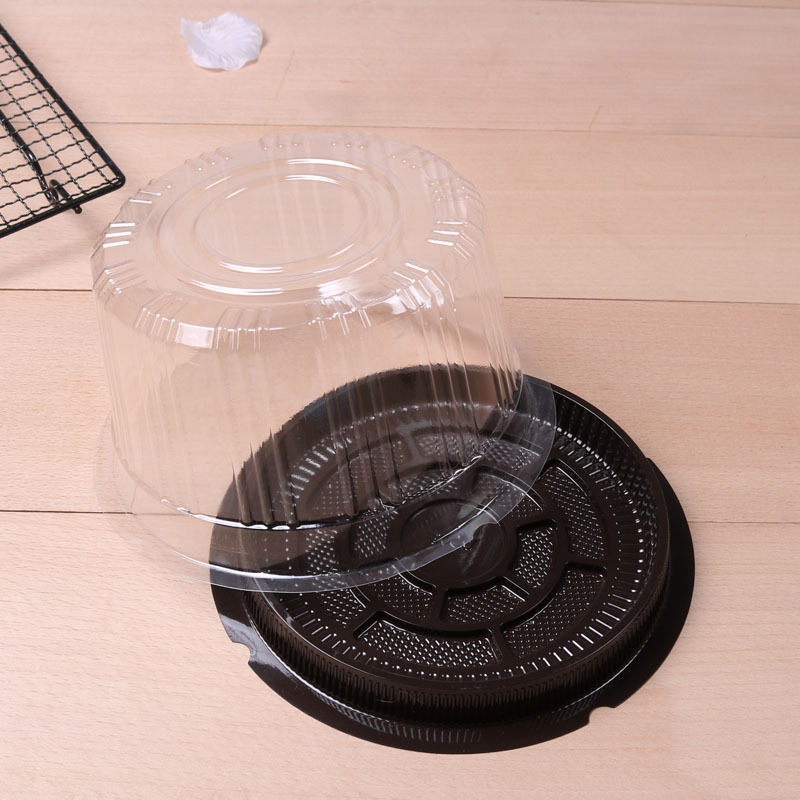
If you source packaging for specific retail environments like grocery store cold cases, you must explicitly detail lid requirements. Open-air displays require high visibility and moisture control. For instance, specify if the RFQ includes a leak proof round cake dome lid for optimal moisture retention and secure transport of display-ready products. Calling out these specialized enclosures ensures suppliers factor in the exact mold fees, vacuum-forming processes, and plastic resin costs upfront.
Bakery items contain high levels of butterfat and moisture. Without a proper barrier, the paperboard acts like a sponge. It absorbs grease, creating unsightly stains and severely weakening the structural integrity over time. Define your coating requirements meticulously. Options include Polyethylene (PE) lining, which offers excellent grease resistance but limits recyclability. Aqueous coatings provide a more eco-friendly water-based barrier. Compostable PLA (Polylactic Acid) films offer excellent grease resistance for brands committed to strict environmental standards.
Your packaging serves as a mobile billboard for your bakery. Vague aesthetic requirements lead to mismatched brand colors and peeling window films. You must outline these tolerances strictly.
Define the exact color model your brand uses. Indicate whether the supplier should print using CMYK (for complex, multi-color photographic designs) or Pantone/PMS spot colors (for exact brand color matching). You must also specify the coverage area. Will you require printing only on the outside exterior, or do you expect full-color printing on the inside as well? Inside printing requires specialized food-safe inks and adds significant cost.
Follow this checklist when formatting print specifications:
Visual merchandising often requires a window box. If you request this feature, specify the exact window material. Common choices include PET (highly clear and recyclable) or PVC (cheaper but less environmentally friendly). Outline the exact die-cut placement using a CAD drawing. Crucially, note the requirements for adhesive strength. Cold environments cause standard adhesives to fail. You must mandate freezer-grade glue to prevent window films from peeling away from the cardboard in refrigerated display cases.
Premium branding often relies on tactile finishes. Detail any foil stamping, embossing, debossing, or UV spot treatments required. Specify the overall lamination style—matte, gloss, or soft-touch. These embellishments significantly impact the final unit cost. They also require expensive metal tooling dies. Including these details in the initial RFQ prevents unexpected setup fees later in the procurement process.
Once you distribute your rigorous RFQ, you will receive multiple bids. Comparing them requires a strategic approach. You must look beyond the bolded unit price to uncover the true viability of a manufacturing partner.
Evaluate the comprehensive financial impact of each bid. Look well beyond the per-unit price to identify hidden fees. A quote might show an incredibly low unit cost but hide massive custom sampling charges. You must ask vendors to itemize die costs, printing plate fees, and estimated shipping or freight charges. A local cake box supplier might charge more per unit but save you thousands in ocean freight and import duties compared to an overseas vendor.
Minimum Order Quantities (MOQs) dictate your cash flow and warehousing needs. Require the manufacturer to provide price breaks at multiple volume tiers. Ask for quotes at 5,000, 10,000, and 50,000 units. Evaluating these tiers helps you determine the long-term partnership viability. A supplier might offer a great price at 5,000 units but lack the mechanical capacity to scale efficiently when your business demands 50,000 units.
Food packaging carries inherent consumer safety risks. You must mandate the inclusion of compliance certificates as part of the vendor qualification process. Demand FDA or EU food contact compliance documentation for all substrates and inks. If your brand emphasizes sustainability, require credentials like FSC (Forest Stewardship Council) certification for paper sourcing and ISO 9001 for quality management systems.
Never approve a mass production run based solely on a digital PDF proof. Set firm expectations for a prototyping Service Level Agreement (SLA). Demand a structural blank sample (unprinted) first to test sizing, assembly speed, and weight limits. Once approved, require a fully printed prototype to verify color accuracy and finish quality before mass manufacturing begins.
A rigorous RFQ serves as much more than a simple pricing inquiry. It acts as a strict contractual safeguard and establishes a non-negotiable quality assurance baseline. By defining precise internal dimensions, load-bearing capacities, and food-safe material requirements, you eliminate vendor assumptions. You protect your profit margins from the hidden costs of operational failures and ruined inventory.
Procurement teams should adopt the parameters outlined above to build a standardized, repeatable template for all future packaging bids. Do not settle for vague promises of "standard" quality. Take control of your supply chain by dictating the exact technical requirements your brand needs to succeed.
Now is the time to audit your current procurement strategy. Contact your manufacturing partners with a fully fleshed-out specification sheet. Request comprehensive sample kits, demand transparent itemized pricing, and secure the high-quality packaging your products truly deserve.
A: GSM (Grams per Square Meter) measures the actual weight of the paperboard, commonly used in international and Asian markets. PT (Point) measures the physical thickness (caliper) of the board, frequently used in North America. One point equals 0.001 inches. Both metrics define material sturdiness, but you must use the standard relevant to your manufacturer's region to avoid confusion.
A: You should almost always request flat-packed boxes. Shipping pre-assembled boxes means you pay to transport empty air, which skyrockets freight costs. Flat-packed items save massive amounts of warehouse space and drastically reduce landed shipping expenses. Only request pre-assembled components for highly complex, rigid luxury boxes.
A: Measure the total height of your tallest finished cake, including cake boards, dowels, and top decorations. Add a minimum of 1.5 to 2 inches of clearance to that measurement. Specify this final number strictly as the "Internal Usable Height" on your RFQ to ensure frosting never touches the lid.
A: You must demand documentation proving FDA (US) or EFSA (Europe) compliance for direct food contact. This applies to substrates, coatings, and inks. Additionally, request ISO 9001 for quality control and FSC (Forest Stewardship Council) certification to guarantee sustainable paper sourcing.


