
Views: 0 Author: Site Editor Publish Time: 2026-10-16 Origin: Site


In modern food retail, packaging acts as the final protective barrier. It stands between a delicate product and costly physical shrink. It also serves as your primary vehicle for visual merchandising. Shoppers buy premium baked goods using their eyes first. They expect perfect presentation on crowded supermarket shelves. Specifying the wrong material or structural design creates immediate problems. It often leads to compromised cold-chain integrity. You might face poor shelf stacking stability during retail display. You could also fail strict food safety compliance audits. These mistakes damage brand reputation and reduce overall profit margins. This guide provides a detailed technical and commercial framework. It helps procurement teams evaluate, specify, and source reliable solutions. We will show you how to design a PET dessert tray flawlessly. You will learn to guarantee superior optical clarity. We ensure structural integrity remains intact during transit. We also cover essential regulatory compliance mandates for food safety.
The business case for PET is exceptionally strong. Polyethylene Terephthalate (PET) dominates the food packaging industry globally. It offers unparalleled optical clarity. Premium desserts require high-visibility presentation to drive sales. Shoppers want to see the exact texture of a cake. They need to inspect frostings and delicate fillings before purchasing. PET provides a premium, glass-like transparency. It outperforms cheaper alternatives significantly. Polystyrene (PS) represents an older packaging standard. PS is highly brittle and prone to cracking. It also lacks the crystal-clear look of PET. Polyvinyl Chloride (PVC) offers good clarity but carries severe risks. PVC raises major environmental and health concerns. Many regions strictly prohibit PVC for direct food contact today.
Material Performance Comparison
| Material | Optical Clarity | Moisture Barrier | Heat Resistance | Food Safety |
|---|---|---|---|---|
| PET | Excellent | High | Low (<60ˆC) | Excellent |
| PS | Fair | Medium | Low | Good |
| PVC | Good | High | Low | Poor |
Temperature thresholds require your careful attention. You must match the material to the display environment. PET performs exceptionally well in refrigerated display cases. It maintains structural integrity at standard chilling temperatures. Cold environments do not make standard PET overly brittle. However, hot display environments pose a major structural risk. Standard PET begins to soften and deform above 60ˆC (140ˆF). You cannot use it under hot deli warming lamps. Heat causes the plastic to warp rapidly. Warping destroys the package seal and exposes the food.
Barrier properties directly impact your bottom line. PET extends shelf life in retail settings effectively. It provides an excellent barrier against environmental moisture. It also blocks oxygen transmission efficiently. A tight moisture barrier keeps baked goods extremely fresh. It stops crispy pastry shells from becoming soggy. It prevents sponge cakes from drying out prematurely. Effective oxygen barriers delay fat oxidation in buttercreams. Extended shelf life reduces retail food waste significantly. Lower waste metrics protect your profit margins directly. You sell more products and throw away less.
You must specify the correct gauge for your application. We measure material thickness in mils or microns. The right gauge depends heavily on the product weight. A lightweight box of macarons needs thinner plastic walls. You might specify a 12-mil or 15-mil thickness. A dense fruit tart demands much higher structural support. You should consider a 20-mil or 25-mil gauge here. You must also account for vertical stacking height. Retail shelves often require stacking trays four or five high. The bottom tray bears the entire cumulative load. If the gauge is too thin, the bottom tray crushes. Balancing rigidity against material reduction requires engineering skill. Thinner trays save significant raw material costs. They reduce your overall environmental footprint. However, under-engineering leads to crushed products. You must test load-bearing capacity physically before ordering.
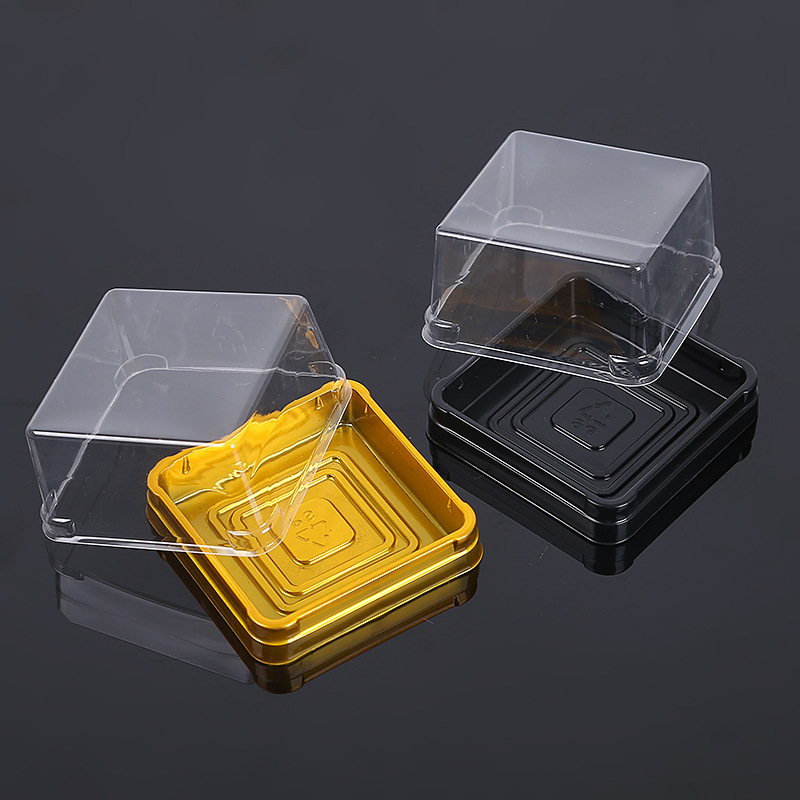
Precise dimensional tolerance prevents costly transit damage. You must design the internal cavity to fit the product exactly. Excessive movement inside the package destroys delicate decorations. Compartmentalization solves this problem for multi-item sets. Designing individual cavities isolates each piece safely. For example, specifying a PET mooncake tray requires precise engineering. Each heavy mooncake sits securely in its own protective pocket. They cannot slide and smash into one another. Draft angles represent another critical design element. A draft angle is the slight taper on vertical walls. You should specify draft angles between 5 and 7 degrees. Proper angles are critical for the de-nesting process. Automated packaging lines use suction cups to pull trays apart. If walls are too straight, vacuum suction locks them together. The automated line stops, causing costly production downtime.
Closure style determines how the package functions daily. Snap-fit button locks offer quick, manual closing. They provide a satisfying audible click when secured. Workers know instantly the package is sealed correctly. Hinge closures keep the lid and base connected permanently. This simplifies inventory management for the packaging itself. Heat-sealable films offer an alternative to hard lids. You need a flat perimeter flange design for heat sealing. Film seals provide superior long-term barrier performance. Tamper-evident designs are now a retail necessity. Modern grab-and-go environments demand high security. Consumers want visual proof confirming nobody opened their food. Tamper-evident hinges break visibly upon opening. They build consumer trust immediately upon inspection.
Food safety certification is absolutely mandatory. You must verify all food-contact compliance claims immediately. Never assume a plastic material is automatically food-safe. In the United States, materials must meet FDA 21 CFR 177.1630. This regulation governs polyethylene phthalate polymers. In Europe, you must comply with EU No 10/2011. These regulations require strict chemical migration testing. Testing ensures harmful chemicals do not leach into food. You must demand current compliance certificates from your manufacturer. Keep these documents on file for unexpected retail audits.
Sustainability mandates influence material choices heavily today. Corporate sustainability goals often require integrated recycled content. Recycled PET (rPET) offers a highly commercially viable solution. It helps brands meet strict internal environmental targets. It also addresses local plastic tax regulations. Many governments now tax packaging made from 100% virgin plastic. Integrating rPET lowers or eliminates these new tax burdens. However, rPET can sometimes display a slight yellowish tint. You must evaluate the visual impact on your product. Many manufacturers use A-B-A co-extrusion technology to solve this. This process sandwiches a core layer of rPET between virgin PET. It guarantees a virgin food-contact surface while utilizing recycled material.
Traceability protects your brand during a sudden crisis. Ensure the chosen vendor maintains strict lot-tracking protocols. They must trace every batch of resin to the final tray. You also want a vendor operating ISO-certified cleanrooms. Dust and particulate matter ruin pristine food packaging. Class 100,000 cleanrooms filter out these airborne contaminants. This prevents physical contamination during the thermoforming process.
Tooling capabilities dictate your ultimate speed to market. Assess the vendor's speed and cost for mold creation. During the sampling phase, you need quick prototypes. Cheaper, short-run epoxy or plaster molds work beautifully here. They cost less and take only days to produce. However, they degrade quickly after a few dozen pulls. For full production, you need CNC aluminum molds. Aluminum molds are expensive but extremely durable. They feature internal water-cooling channels. This speeds up production cycle times significantly. Ask vendors if they design custom tooling in-house. In-house tooling departments resolve design flaws much faster.
Quality Assurance and Quality Control (QA/QC) matter immensely. Look deeply into a supplier's quality control documentation. Do not just accept a basic verbal guarantee. You want to see standardized physical drop testing results. They should use ISTA (International Safe Transit Association) testing protocols. Assess their crush resistance data for stacked pallets. If using heat seals, ask about seal leak testing. Vacuum chamber tests identify microscopic leaks easily. A robust QA/QC process catches defects long before shipping.
Lead times and capacity require honest evaluation. A vendor might perform beautifully during a small pilot run. They might fail entirely during a full retail rollout. Evaluate their machine count and overall facility size. Ask about their resin supply chain stability. Can they secure raw materials during global market shortages? You need a partner capable of scaling operations seamlessly. Quality degradation often happens when a small vendor rushes. Ensure they have the capacity to handle your peak seasonal volumes.
Evaluating your dessert packaging early prevents costly downstream errors. Freight and nesting efficiency play a massive role here. How a tray design stacks impacts shipping volume directly. Trays must nest tightly together inside the carton. A poorly designed tray leaves large gaps between units. You end up paying to ship empty air across the country. Tight nesting exponentially increases overall freight density. You fit thousands more units onto a single pallet. This reduces shipping rates and lowers carbon emissions. Always measure the stack height of 100 nested trays.
Hidden tooling fees can ruin your procurement budget. You must establish completely transparent accounting upfront. Clarify who owns the physical mold after you pay for it. Some manufacturers try to retain ownership of custom tooling. Ask about ongoing mold maintenance and storage fees. Molds require regular polishing and industrial cleaning. Determine if maintenance is included in the unit price. Clarify the actual cost of minor design revisions. A small change in cavity size should not require a completely new mold fee.
You must mitigate common production and transit failures proactively. Cold-temperature cracking represents a major risk factor. Standard PET becomes brittle slightly below freezing. If you blast-freeze your desserts, standard trays will shatter. You must specify impact-modified PET for sub-zero applications. Lid popping during transit is another frequent failure. Changes in atmospheric pressure during trucking cause this. Ensure the button locks have sufficient mechanical bite. Static buildup on the production line causes massive headaches. Friction during thermoforming generates heavy static electricity. Trays stick together and refuse to de-nest easily. Require your vendor to apply a food-safe anti-static silicone coating.
Specifying retail-ready packaging requires careful balance. You must weigh aesthetic visibility against rigorous physical requirements. You cannot sacrifice food safety for a slightly lower price point. Clear material, precise gauge, and strong locks ensure retail success. Your baked goods will survive transit and look stunning on the shelf.
Procurement teams should initiate this process methodically.
A: Tooling costs vary based on mold complexity and material. A single-cavity epoxy prototype mold might cost a few hundred dollars. A multi-cavity CNC aluminum mold for high-volume thermoforming typically ranges from $2,000 to $8,000. Features like custom logo embossing or intricate compartmentalization will increase the final engineering cost.
A: Standard PET can become brittle and crack at sub-zero temperatures. If you intend to blast-freeze your products, you should communicate this to your manufacturer. They will recommend specific impact-modified PET blends or alternative materials like CPET (Crystallized PET) designed explicitly for extreme cold environments.
A: APET (Amorphous PET) is simply the standard, clear form of PET used in thermoformed food trays. The amorphous structure gives the plastic its high optical clarity. In the packaging industry, procurement professionals use the terms PET and APET interchangeably to describe the exact same clear material.
A: Thermoforming machines require significant setup time and energy to calibrate. Running low volumes makes this setup phase disproportionately expensive per unit. Higher MOQs spread these fixed setup costs across thousands of trays. Committing to larger production runs is essential to achieve competitive, cost-efficient unit pricing.


